Torta al testo
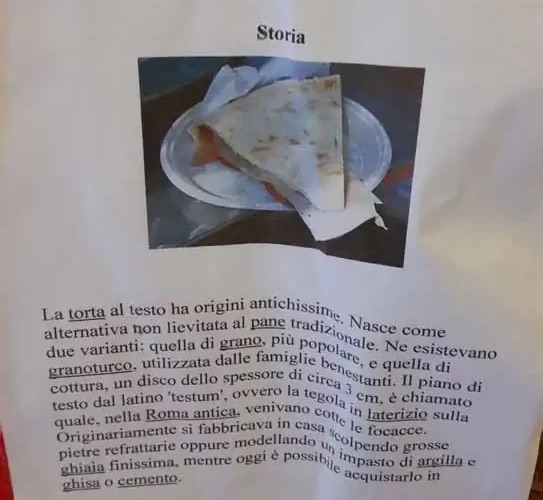
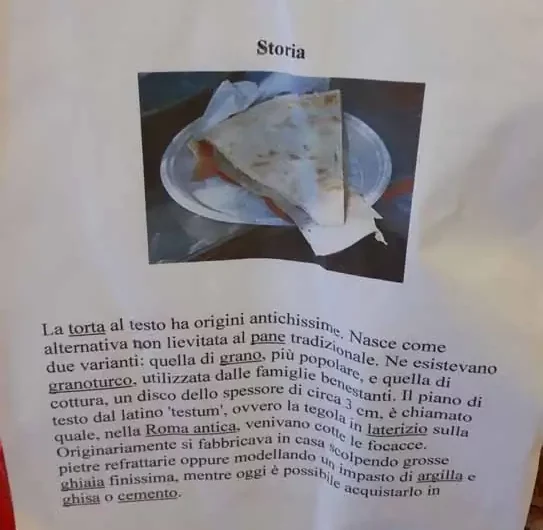
The torta al testo has ancient origins.
It originated as an unleavened alternative to traditional bread.
There were two varieties: the more popular wheat version, and the maize version, which was used by wealthier families.
The cooking surface, a disc about 3 cm thick, is called a ‘testo’, from the Latin ‘testum’, meaning the brick tile on which flatbreads were baked in ancient Rome.
Originally, it was made at home by carving large firebricks or moulding a mixture of clay and very fine gravel, whilst today it can be bought made of cast iron or concrete.
[Source: Citizen of Catiglion del Lago (PG)]
Torta al testo
Course: Contorni, Prodotti tipiciCuisine: Umbria, ItaliaDifficulty: bassa4
porzioni30
minutes40
minutes1
hour10
minutesThe testo cake has ancient origins.
It originated as an unleavened alternative to traditional bread.
There were two varieties: the more popular wheat version, and the maize version, which was used by wealthy families.
The cooking surface, a disc about 3 cm thick, is called a ‘testo’, from the Latin ‘testum’, meaning the brick tile on which flatbreads were baked in ancient Rome.
Originally, it was made at home by carving large firebricks or moulding a mixture of clay and very fine gravel, whilst today it can be bought made of cast iron or concrete.
Ingredienti
250 g white flour
1 whole egg
25 g of grated Parmesan
15 g of grated pecorino
15 cc of milk
10 g extra virgin olive oil
1/2 sachet of instant yeast
Water, as required
1 Umbrian text
Preparazione
- Place the flour on a work surface and make a well in the centre, into which you should add the eggs and cheeses
Add the oil, milk and yeast dissolved in a little lukewarm milk - Mix thoroughly and, using lukewarm water, knead carefully until you have a soft, smooth dough
- Divide the dough into two portions and roll them out on a work surface to form two round pizzas about 1 cm thick
- At the same time, heat the testo on the gas hob, sprinkling it with flour (when the flour turns golden, the testo is ready for cooking)
- Place the cake on the baking tray, prick it with the prongs of a fork and turn down the heat under the baking tray
- The cake will be ready when it has risen and is a nice golden colour
- It goes well with cold cuts and meat main courses served with a sauce
Acquista